Synthesize

As a former keyboard player on the church worship team during high school, the word synthesize brings to mind synthesizer, a collection of various electronic sounds possible at the touch of my fingertips on the Roland instrument. Anything from a jazz organ to a grand piano to an ethereal soundscape, my hands were busy on Sunday mornings as I filled the spaces of people’s auditory experience with chords that would accompany their singing of praise songs in the worship service. Together with my fellow musicians, we created something powerful, something beautiful.

Now the word takes on a different tone for me, having just completed an academic course on entrepreneurial mindset, but it might as well have been a course on how to think critically. The professor had laid out clear guidelines on how to engage in the discussion boards: build on each other’s posts to further the discussion, reference the texts you read, don’t just summarize but synthesize the ideas. This exercise in engaging thoughtfully with my classmates (along with specific feedback from the professor on how to improve discussion techniques) led to a rich educational experience in not just how to have productive discussions, but how to think better. How does the text tie in with the points the discussant is making? How does that build on the concepts we learned last week? What additional questions does this bring up? It almost didn’t matter what the discussion topic was about, because the skillset we were cultivating was one we could carry into everyday life.

Like a synthesizer keyboard that helps the band blend to create beautiful music, so the ability to synthesize ideas brings people together in harmony. Business coach Jadah Sellner is known to have said, “There are no unique messages, only unique messengers.” And yet it’s the uniqueness of those messengers that allow the important messages of life to land for those who receive them. A musical scale has a finite number of pitches, and yet there are countless songs that have been written using those same pitches over and over again in unique ways. There are a finite number of musical instruments, but the auditory textures those instruments bring, both individually and collectively, create countless sound experiences for the listener. Likewise there are common principles, nuggets of wisdom, tropes and archetypes repeated across history, and yet it’s the ability of the messengers to recognize the patterns and communicate those patterns to others that makes it feel as if the receiver is hearing good news for the first time. When we learn how to synthesize ideas, to tie concepts together, to integrate our knowledge and experience with what we learn, we bring a freshness to the patterns around us, making new connections where there were none before.

In a recent conversation about declining literacy rates across the U.S., it was pointed out to me that literacy doesn’t just mean the ability to read words, it’s the ability to comprehend information being conveyed as well as integrate that information to better navigate the world. Integration is how we make connections; the better we understand, the better we communicate and vice versa. If we can make connections between ideas, we can better make connections among people. And this connectedness is what allows humans to flourish; it’s what makes the music of life.

Now that the academic course is over, I find myself craving more discussions, more ways to ideate, to connect, to make that music. I often find solace in the pages of a book, reading the words of people much more knowledgable than I on various subjects. But less often do I discuss what I read with others, applying that knowledge to my own life. It’s as if the creative cycle is truncated sometimes. A book really isn’t complete upon the turning of the final page; a book is complete when you’ve shared the message with another. And many books on my shelves remain incomplete.

So now I ask myself where and what to synthesize next. What ideas are beckoning to be heard? What connections are waiting to be made, if only I would reach out and facilitate them? A Roland keyboard makes no sound unless I’m willing to place my hands on the keys. A book touches no lives if I cannot turn the page. The process takes practice, but so do all good things. Shall we make music together?

Comparing Classical and Celtic Harps

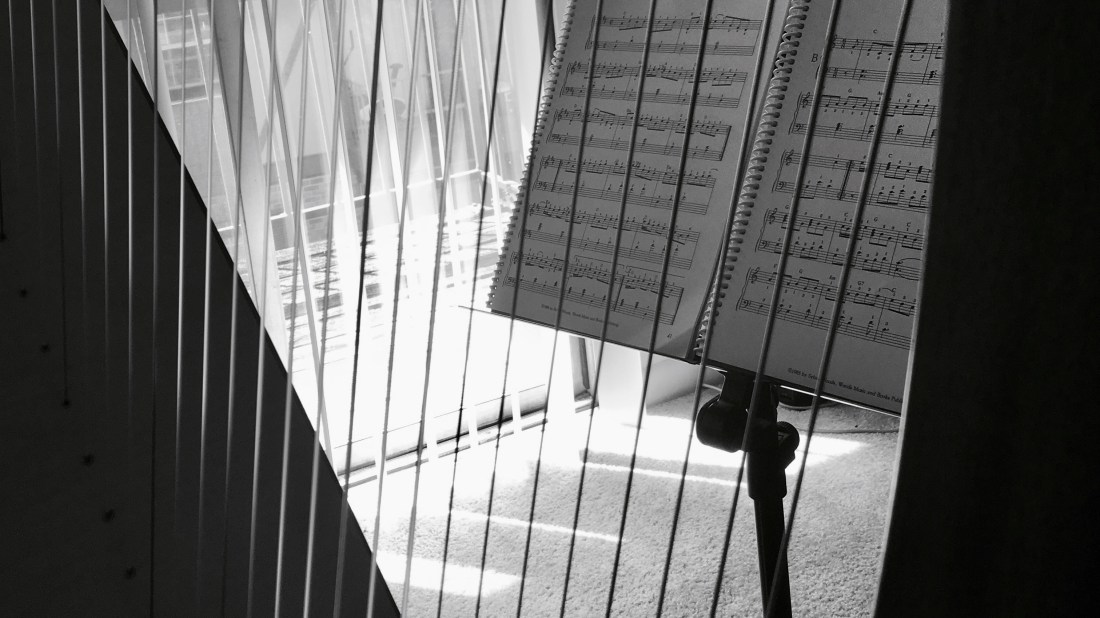
Countless people have asked me about the instrument I play – how it works, how big it is, what the little switches are at the top. So I thought I’d write a post to answer some of the common questions I receive.

In the US, there are two main types of harps people play: the classical harp (or pedal harp) and the Celtic harp (also called the lever harp or folk harp). There are many kinds of harps, but those are the two most common categories.

The classical/pedal harp is a harp used in orchestras. It tends to be big and loud, and is characterized by the foot pedals it has at the bottom. The Celtic harp, or lever harp, is usually smaller and does not have foot pedals. Instead, it has little levers at the top of each string. Pedals and levers both have the same purpose: to change the pitches of the strings.

Each string produces a certain pitch depending on the tension of the string. Just like a rubber band changes pitch the more/less you stretch it, so harp strings change pitch if you use pedals or levers to change the strings’ tension.

Quick summary: the levers and pedals on Celtic and classical harps are there to change the tension/pitches of the strings.

Here I will elaborate a little more on the differences between levers and pedals. In music, each note is named with a letter (A, B, C, D, E, F, G). If a note has a sharp (#) or a flat (b) next to it, that implies a pitch that is halfway between two letters. So instead of saying F 1/2, you say F-sharp (F#). The levers and pedals are what allows the harpist to have those in-between pitches. On a classical harp, a simple press of a pedal will change every F to an F-sharp. On a Celtic harp, there is one lever per string, so that means the harpist has to flip the lever on each F string to change it to F-sharp.

The simple pedal mechanisms on a classical harp make it easier to play more complicated classical music. The more complicated levers on a Celtic harp tend to encourage the playing of simpler, more folk-type songs.

I have yet to learn how to play a classical harp, although I probably should someday. But right now I’m quite content playing my little Celtic harp.

“Harp Life” – My Social Media Image

Most of my harp life is pretty boring. I play a few weddings a year, and if I’m lucky I might even participate in a recording project or two. Lately I’ve been trying to “revamp” my online image, and it’s a strange journey to say the least.

Anyone who wants to market themselves as a business online knows the importance of consistency. Depending on the nature of the business and the platform on which it is being promoted, marketing professionals will recommend posting several times a week, if not per day. This will vary across platforms such as Facebook, Twitter, Pinterest, WordPress, etc. The fun part is I enjoy making online content look pretty. The funny part is my life is not as action-packed as I promote it to be. Yet promotions are important to keep oneself relevant, talked about, noticed.

Lately I have been focused on streamlining my image to promote myself as a harpist, and I am working to become more consistent with that across my social media platforms. When I first started this blog, it was in attempt to narrow down my decision on an undergrad major. If you read my older posts, you may see an evolution of my growth, but often I feel like my thoughts are all over the place. Ultimately I have kept this blog going because I enjoy writing about life and things I’m learning or am passionate about. But consistency has always been hard for me.

Still, my efforts are a work in progress, and I’m enjoying the progress I’m making this year.

photo by Sarah Cannavino


Harp Practice and the Art of Bullshitting

People are surprised when I tell them I don’t practice the harp a lot. Allow me to introduce you to the art of musical bullshitting.

If you have a background in classical music (or perhaps music of any sort), you know the importance of practicing your instrument to improve and grow. When I first started playing the harp I hated practicing. I still do, actually. So I guess my brain developed a way to “cheat” a little.

Because I mostly play solo for small events, I have freedom to arrange and play music the way I want to. From little on up I always preferred learning music by ear instead of reading music. I learned how to improvise, and that has allowed me to pretend I know what I’m doing even when I don’t. However, that mainly works in a non-classical music setting. Put me in an orchestra and I’m lost.

While I don’t like practicing, I do like playing. Someone I know once told me he viewed the idea of playing music like you would play a game, and that perspective is what made it fun. So I play the harp somewhat regularly, and sometimes that will turn into practice – reviewing songs in my repertoire, or challenging myself to learn a new song I heard on the radio. If I have a performance to prepare for, I will brush up on specific songs. I have become familiar enough with my harp to rely on muscle memory and my ear.

Playing over practicing is a mindset I allow myself to have as a part-time musician. It is something I can do when I come home from a stressful day at work. And it is something that doesn’t have to feel like a chore, because it puts me in a semi-meditative state. When, as a musician, I allow the music to touch me similarly to how it touches others, that’s how I know I’ve achieved a healthy level of play.

Creating an Ideal Day

I often think of things I wish I could accomplish in a given day if I could only muster the motivation to do them. Sometimes they are even things I enjoy doing but haven’t developed the discipline for turning them into regular habits. Therefore, I have decided to list tasks I would love to accomplish in my ideal day:

  • Write in my blog/practice writing in general
  • Read 50 pages or so in any given book
  • Devote time to a yoga practice
  • Practice harp/work on reading music
  • Draw
  • Work on quilt or some craft project
  • Write to a friend
  • Create (bake) something in the kitchen
  • Practice singing
  • Clean/organize something around the house
  • Devote time to spiritual reflection/reading/prayer
  • Bask in sunshine

Last year I had made a list of goals (resolutions, perhaps) which I did not accomplish in 12 months time, other than reading 15 books and cleaning out my car (for I had to get rid of it). This year I want to focus on furthering my self care routines. Since one of the most common New Year’s resolutions this year is to “become a better person,” which is ridiculously vague, I have decided to create my own goals to strive for and grow into.

My list above is not one I can realistically expect to complete daily; however, it helps to outline my ideal day. Because of this, I have something tangible to work toward in making every day an ideal day, whether I complete the list or not.


Long Hunter Pow Wow

My tires matted the grass as I turned off the main road, into the middle of nowhere, also known as Long Hunter State park. From the moment I stepped out of my car, I could hear the mournful voice of a Native American flute winding its way through the trees and to my anxious ears. I had gotten a great parking spot by the entrance of the festival, and my first destination while there was the bleachers surrounding the small stage where the performance was taking place.

While walking through the clearing in the wood, I felt overcome with a sweet sadness I didn’t know how to reconcile. My soul wept with the sky in my loneliness, and yet I wouldn’t have had it any other way. Seeing the livelihood of a people who are too often invisible to me reminded me of my need to connect with nature, to bask in the beauty of the earth. Solitude has a way of doing that to you: of wringing your heart free of the shallowness of petty problems and leaving behind a core of raw emotion, an essence of what it means to be human.

I walked around the field for hours, visiting the different vendors and admiring their art. Not wanting to leave, yet not wanting to stay, I had to tear myself away like a child from her mother. Something inside me connected to this culture, to the stories, the traditions, the heartache. A connection which only a deep loneliness could reveal in its rugged beauty.

I, Songwriter

I thought I wanted to be a songwriter until I realized what went into writing a good, popular song.

As a child, I grew up in a religious (and sheltered) home, so I patterned some of my first songs after hymns, which could have up to seven verses. Not until I was older did I realize most songs have only two verses, because that’s all that can fit into a song most people will listen to.

As I wrote more, I became more creative with beats and instrumentation, but my songs were still overtly religious. The famous saying goes, “Write what you know,” and that really was all I knew. But my musical tastes began to change, and I listened to more mainstream music. My eyes opened to a vast world waiting to be explored. I had had no idea just how big and diverse the world was until I entered college.

A lot of songs you hear these days revolve around love, breakups, sex, and going to clubs, among other experiences, many of which I have never encountered. I have learned much just by listening to songs many deem shallow or cheesy. Songwriters will say they write from their experiences, and people relate to them. I desire to relate, not because I want to be just another crowd-follower, but because I want to understand the people around me. I want to understand what public school was like, how young people learned about the world around them, how they experienced pop culture.

I cannot write mainstream music because I do not have mainstream life experience – whatever that is. I have been in love before, but I have never had a boyfriend, or gone to a club. Not that these are the only things I need to do to “fit in,” but I still feel very naive about the world. I yearn to grasp the way people interact with each other, what they do on weekends, how they have fun, what gives them meaning. Every person is different, but some life experiences are more common than others.

My lack of common experience limits my ability to write catchy songs. I am not denying that I have something of value to offer the world, I just haven’t figured out what that is and how to do it yet.

When Dark Descends

This evening I am enjoying the warmth and comfort of my apartment, the soft glow of the lamp on my homemade coffee table, the smell of cinnamon and orange drifting through the air from the kitchen. From my cozy corner I contemplate the presence of fear, of darkness, in the context of the surrounding materials shielding me from those horrors, and yet I have had more exposure to those elements than I would ever wish.

I watched an episode on Netflix in which the characters had to face the darkest part of themselves in order to get what they wanted. They had to come to terms with who they were. Coincidently I read a blog post right after that in which the writer suggests we run toward our greatest fears to create our best work. It is in the midst of this situation I find myself contemplating what areas of my life are shrouded in darkness. What do I fear? Who am I deep inside?

Far be it from me to expose my innermost thoughts to the internet, so if that is what you are expecting, I am afraid you will be left wanting. Still, I believe it a challenge to know for sure what our deepest insecurities are without extensive searching and reflection. We do not have a dramatic musical score to tell us when we have solved the riddle. Instead we have mere scraps of music, little bits here and there waiting for us to piece them together into our own song.

Something I fear deeply is being alone. Not physically, for that is how I am most days. It is on a more emotional level I fear I will not find companionship or love. I have no doubt many people love me dearly, but very few are able to come with me to the darkest parts of my heart. Sometimes even I do not dare descend the rickety staircase leading to that dusty basement for the possibility of getting caught in the cobwebs.

In the midst of all this, it is often the advice of many to turn to one’s spiritual health for solace. But I say this: no matter what you believe, it will not always change what you feel. Yes, we must acknowledge our feelings. Yes, we must do what is right despite those feelings, but feelings, fears, and darkness will not always dissipate no matter how hard we try to make them. When hope looks like nothing other than a distant delusion and healing a cruel con, sometimes all we can do is add more measures to our symphony in the making. We cannot yet hear the full piece, only an incomplete cadence. As much as we want to dissolve the dissonance to reach a resolution, sometimes our only antidote is to whisper to ourselves, “Maybe tomorrow.”

Things I Love: Sunday Afternoons

Sunday afternoon, the end of one week, beginning of another. Sometimes I don’t like it because it means that tomorrow is Monday. But it’s not so bad when I’m able to take just a little time to relax.

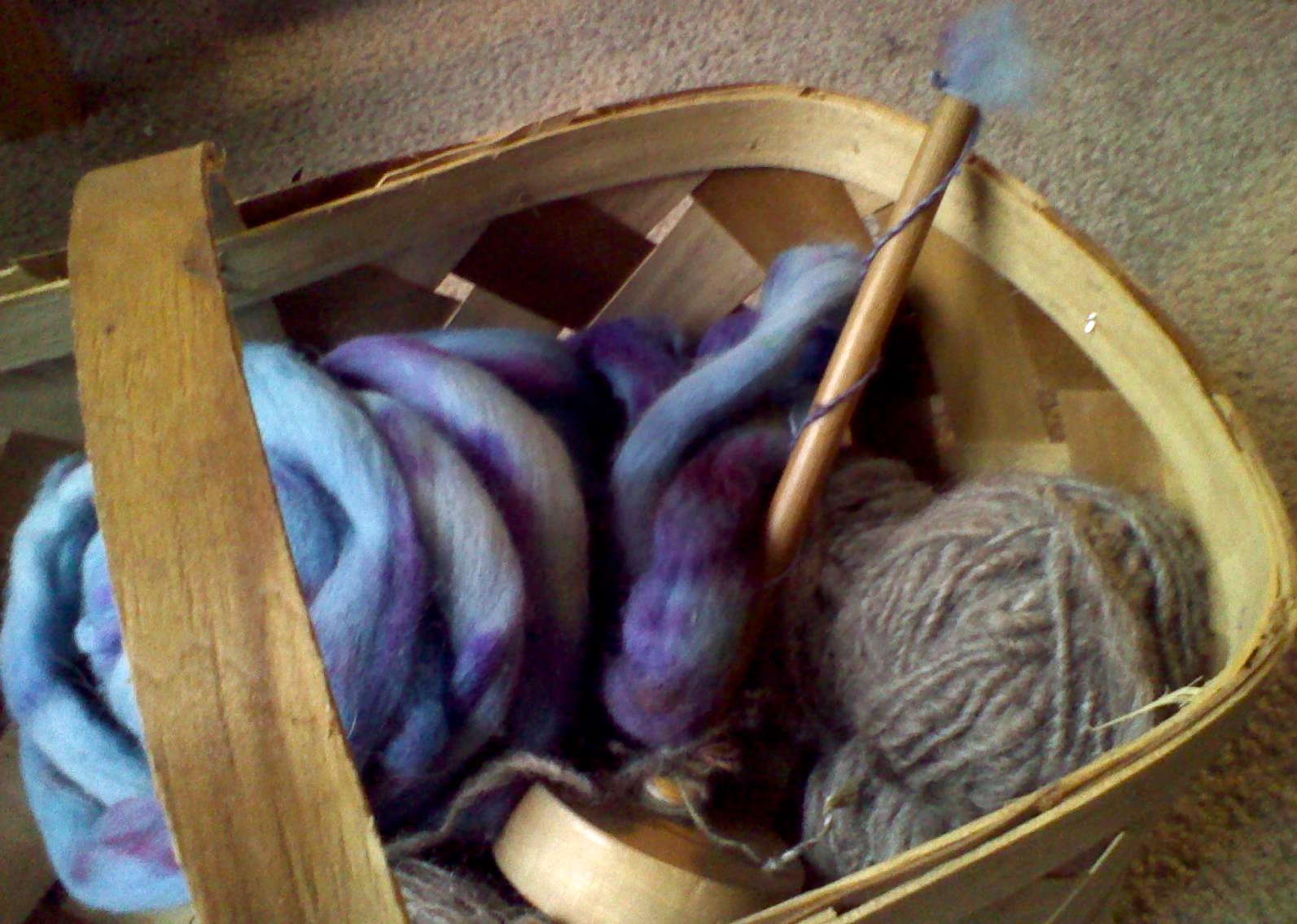
130929_0005

One recent Sunday afternoon, I spun yarn while listening to Norah Jones and drinking green tea. I’ve had a lot on my mind lately; there’s a lot going on, but spinning and listening to music helps to clear my mind.

Yeah, I’m still thinking about things I need to get done, and things I want to get done, but stepping back and taking some quiet time really helps me to feel better.

Maybe you’re busy, but don’t forget to take time to do something you enjoy, something that relaxes you. It will help you be more productive in the long run.

Indecisiveness

Well, it’s official. I am no longer an undecided major. I have declared Multimedia Production as my major.

When I announced the news to my roommates (and after they congratulated me), one of them asked, “Do you feel like this is finally where you’re meant to be?”

“No,” I said. We all laughed.

The truth is, I still don’t know what I want to do, and that’s why I chose a major that’s broad and encompasses different branches of media (video, photography, web design). I would love to go into filmmaking, but I can’t decide what part of it I would want to do. I love working the cameras, but I also like deciding what shots to call. I love editing. I like special effects and am fascinated with green screens. At the same time I’d almost rather be in front of the camera. When I watch movies, I love observing the actors and wondering what the rehearsals were like and the steps they took to develop their characters.

Speaking of actors, I love live theater. Especially musical theater. What I would give to be able to act and sing like the people I see on Broadway as well as other stages. And that leads me to music. I want to learn how to play the cello. I think it’d be cool to learn the drums. I want to become a better pianist. I enjoy playing the harp for people and get excited when I schedule gigs.

There are so many other things that I want to do. I won’t take the time to list them all, but hopefully that gives you an idea of why I can be so indecisive. There are just so many things I want to do. The nice thing about college is that I can take various classes and try new things. But eventually I have to focus on one path, because taking a bunch of random classes won’t get me a bachelor’s degree.

I’m writing this not to complain, but to try to sort out my thoughts as well as express frustrations that go through my head on a daily basis. Many of the things I want to try out are very possible. I can take voice lessons, I can take film classes, I can make my own videos for YouTube if I wanted to.

I can see people who are so passionate about what they’re doing that they will give anything and everything to be able to accomplish their ambitions. What frustrates me is that I can’t find a passion for much of anything. There are loads of possibilities; there are many things I enjoy, but I haven’t yet found something that I’m willing to fight for. Maybe I would find it if I just committed to something. Maybe I’ll find it in my new major. Right now I just committed to it because it seemed to be the logical thing to do.