Comparing Classical and Celtic Harps

Countless people have asked me about the instrument I play – how it works, how big it is, what the little switches are at the top. So I thought I’d write a post to answer some of the common questions I receive.

In the US, there are two main types of harps people play: the classical harp (or pedal harp) and the Celtic harp (also called the lever harp or folk harp). There are many kinds of harps, but those are the two most common categories.

The classical/pedal harp is a harp used in orchestras. It tends to be big and loud, and is characterized by the foot pedals it has at the bottom. The Celtic harp, or lever harp, is usually smaller and does not have foot pedals. Instead, it has little levers at the top of each string. Pedals and levers both have the same purpose: to change the pitches of the strings.

Each string produces a certain pitch depending on the tension of the string. Just like a rubber band changes pitch the more/less you stretch it, so harp strings change pitch if you use pedals or levers to change the strings’ tension.

Quick summary: the levers and pedals on Celtic and classical harps are there to change the tension/pitches of the strings.

Here I will elaborate a little more on the differences between levers and pedals. In music, each note is named with a letter (A, B, C, D, E, F, G). If a note has a sharp (#) or a flat (b) next to it, that implies a pitch that is halfway between two letters. So instead of saying F 1/2, you say F-sharp (F#). The levers and pedals are what allows the harpist to have those in-between pitches. On a classical harp, a simple press of a pedal will change every F to an F-sharp. On a Celtic harp, there is one lever per string, so that means the harpist has to flip the lever on each F string to change it to F-sharp.

The simple pedal mechanisms on a classical harp make it easier to play more complicated classical music. The more complicated levers on a Celtic harp tend to encourage the playing of simpler, more folk-type songs.

I have yet to learn how to play a classical harp, although I probably should someday. But right now I’m quite content playing my little Celtic harp.

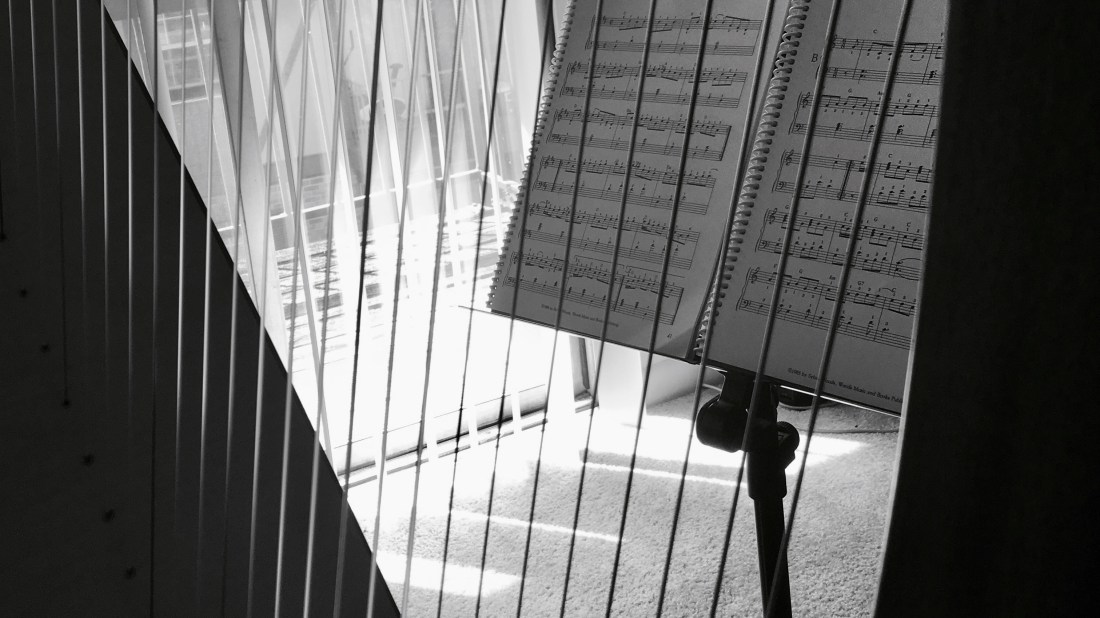
“Harp Life” – My Social Media Image

Most of my harp life is pretty boring. I play a few weddings a year, and if I’m lucky I might even participate in a recording project or two. Lately I’ve been trying to “revamp” my online image, and it’s a strange journey to say the least.

Anyone who wants to market themselves as a business online knows the importance of consistency. Depending on the nature of the business and the platform on which it is being promoted, marketing professionals will recommend posting several times a week, if not per day. This will vary across platforms such as Facebook, Twitter, Pinterest, WordPress, etc. The fun part is I enjoy making online content look pretty. The funny part is my life is not as action-packed as I promote it to be. Yet promotions are important to keep oneself relevant, talked about, noticed.

Lately I have been focused on streamlining my image to promote myself as a harpist, and I am working to become more consistent with that across my social media platforms. When I first started this blog, it was in attempt to narrow down my decision on an undergrad major. If you read my older posts, you may see an evolution of my growth, but often I feel like my thoughts are all over the place. Ultimately I have kept this blog going because I enjoy writing about life and things I’m learning or am passionate about. But consistency has always been hard for me.

Still, my efforts are a work in progress, and I’m enjoying the progress I’m making this year.

photo by Sarah Cannavino


Harp Practice and the Art of Bullshitting

People are surprised when I tell them I don’t practice the harp a lot. Allow me to introduce you to the art of musical bullshitting.

If you have a background in classical music (or perhaps music of any sort), you know the importance of practicing your instrument to improve and grow. When I first started playing the harp I hated practicing. I still do, actually. So I guess my brain developed a way to “cheat” a little.

Because I mostly play solo for small events, I have freedom to arrange and play music the way I want to. From little on up I always preferred learning music by ear instead of reading music. I learned how to improvise, and that has allowed me to pretend I know what I’m doing even when I don’t. However, that mainly works in a non-classical music setting. Put me in an orchestra and I’m lost.

While I don’t like practicing, I do like playing. Someone I know once told me he viewed the idea of playing music like you would play a game, and that perspective is what made it fun. So I play the harp somewhat regularly, and sometimes that will turn into practice – reviewing songs in my repertoire, or challenging myself to learn a new song I heard on the radio. If I have a performance to prepare for, I will brush up on specific songs. I have become familiar enough with my harp to rely on muscle memory and my ear.

Playing over practicing is a mindset I allow myself to have as a part-time musician. It is something I can do when I come home from a stressful day at work. And it is something that doesn’t have to feel like a chore, because it puts me in a semi-meditative state. When, as a musician, I allow the music to touch me similarly to how it touches others, that’s how I know I’ve achieved a healthy level of play.

The Irish Harp

Summer 2012

It was my dream to play a harp in Ireland. I had spent years learning how to play the Irish harp, but only in America. Now that I was in Ireland, I thought it would be fun to play a “real” Irish harp. To my surprise, it was more difficult to find a harp to play than I thought it would be. I explored the streets of Dublin, but I never found the harp store. I visited a music store in Limerick, but all they had were ornamental harps, having no more than 4-10 strings. I became discouraged, but I did not give up hope. I knew I would have one more chance to find a harp during the evening of music at Newport.

When we arrived at the school house which held the event, I stepped inside and eagerly scanned the room. I saw a multitude of children playing violins, accordions, whistles, and drums. Then it caught my eye. Standing off-center in the midst of the children’s ensemble was the instrument I had been looking for: the Irish harp. My body shook, partly from the chilly air and partly out of excitement. I desperately hoped for an opportunity to play before the night ended, but I was nervous too. What would everyone think of me, an American, playing Irish music on an Irish instrument? I hoped that I would do it justice.

When my name was called and I was asked if I wanted to play the harp, I nodded eagerly. Rising from my seat, I stepped toward the front of the room, where the harper from the ensemble set the instrument next to an empty chair. I sat down to get familiar with the harp while Denis Carey introduced the piece I was about to play, which was an original composition of his. I am glad he did the talking; I couldn’t have spoken if I wanted to, my voice being scratchy from my cold. While he spoke, I ran my fingers over the strings, feeling the sound. The tuning was slightly different from what I was used to, so I decided it would be easier to transpose the piece from its original key to the harp’s current tuning so I wouldn’t have to change it. The harp itself stood probably less than 4 1/2 feet tall –– shorter than my harp back home. It rested just beneath my right shoulder as I stretched my arms over the soundboard, ready to play. In a matter of seconds, the introduction was over; it was time to play.

I began to play the first chords of a sad, sweet farewell tune, and the magic melody resonated off the soundboard, reminding me of my harp back home. My fingers glided over the unfamiliar strings –– rougher than nylon, but smoother than gut –– I’m not sure what they were made of, but I enjoyed their timbre. In those few moments, my nervousness, the cold, and the people listening all disappeared as I became absorbed in playing. In those moments, nothing existed but the music and me. I played a few wrong notes, which I hoped I covered up smoothly enough, but it almost didn’t matter. The harp was playing itself, and I was along for an enchanting ride.

As the notes of the final chord drifted away into the air, the room erupted with applause. I stood, smiling, and began to walk back to my seat. I received several compliments on my playing from people on the way, but there was no greater compliment than the praise from the composer himself, Denis Carey. I hoped he hadn’t noticed the wrong notes I had struck, and he didn’t appear to. His smile was almost as wide as mine as he told me how much he enjoyed my playing.

I sank back into my seat, filled with a joy deeper than words. My dream had come true.

My Thoughts Today: Singing

I was having a few thoughts. And when I have a few thoughts, I like to write them down to try to sort them out. And the sort of thoughts I was having today involve what things I enjoy. I was contemplating my desire to sing. I want to sing because I want to sing for people on a stage. I want to sing for people on a stage because I have been moved so deeply by people who sing on a stage, and I want to move people in the same way.

The next idea in my thought process is that I don’t know if I really like to sing. I don’t like to practice at all. Perhaps if I were alone more often I would enjoy singing by myself more. But I would just as happily play the harp or read a book or edit a video instead. I must admit, though, that when I hear music I feel the need to hum along, and I can’t resist making up a harmony. I love doing that, even if people around me don’t love me doing that. But it’s fun.

My next thought is that when I first started playing the harp I didn’t enjoy it very much either. I hated practicing that as well, and I couldn’t see much of a future in it. I was, however, a very young child at the time, and could not perceive where my playing would take me. I am thinking that perhaps I am still a young child in my singing journey, because while I do not enjoy practicing the exercises, something useful may come of it later, even if I can’t imagine what.

Things I Love: The Harp

“I had a dream that you were older and you were playing the harp for a lot of people.” I don’t remember what her exact words were, but I remember her telling me that.

In a way, her dream came true.

I was only around six years old when I began playing the harp. People ask me how I got started playing such a unique instrument, and I really don’t remember. I went to a harp teacher’s house for a lesson one day. And then I went to another lesson. And another. I grew to like the Irish woman with long hair who had a quirky sense of humor and a patient heart. My little fingers were clumsy on the small harp, but I never remember her becoming cross with me.

I loved my teacher, but I hated practicing and wanted to quit. My family kept telling me that I would regret it when I was older. I didn’t have much of a choice but to keep playing.

A couple years later I grew bigger, which meant I could play a full size harp. I had gotten better at playing, so now I could play more complicated songs. And now my teacher could play duets with me. We played mostly Celtic songs, ancient melodies that had stayed alive only by being passed down by people listening to them and playing them back. And that’s what my teacher did with me. She played part of a song, and I played it back. Once I learned the whole song, we would play it together.

Some of my favorite lessons took place when it was chilly outside. My teacher would build a fire in her wood burning stove, and we would make music together while the cats wrestled in the warmth that radiated from the stove. Everything was cozy, and the happy feeling I got would linger through the next morning upon the realization that my shirt smelled like smoke.

I stopped playing after my teacher stopped teaching. Every once in awhile I would pluck a few strings, play a song here or there, but not like I used to. It wasn’t until my later teenage years that I got back into it again. I don’t remember why I did other than for the offer of money I received.

The first few performances I played are a bit of a blur. The more I played, the more I wanted to play.

After most of my performances now there is at least one person who comes up to me to express their appreciation for my playing. A young boy who is learning how to play, a middle-aged woman with tears in her eyes, an old man who squeezes my hand. A pastor, a waitress, a kid who had never even seen a harp.

I’ve gotten to play for a lot of people. Because it makes other people happy. “I was having a hard day, and this was what I needed.”

When I see how I’ve made people happy, it makes me happy too.